Showing posts with label EUR. Show all posts

Wednesday, 17 October 2012

So my masters started (part 2)

Hello everyone.

Continuing from my last post, there are often people who claim to be traders, but all they are doing is gambling - risking too much of their equity (money), and being led through an emotional roller-coaster as the market moves.

What made me attracted to Forex is the fact that you can protect yourself from losing more money than you are comfortable with.

Let's imagine another situation. Imagine I sold 1 lot EUR:CHF (Euros:Swiss Francs) at the exchange rate 1:0.8000. This means I have effectively exchanged 100,000 Euros for 80,000 Swiss Francs (For more clarification on how a trade works, look at the table in this post for a clear explanation of trade dynamics).

I sold 1 lot because I anticipate CHF to strengthen, which means that 1 Euro be able to obtain less Swiss Francs. If the CHF strengthened to 1:07932, and I then closed my trade, I would have made a profit of 680 Swiss Francs.

There is something important to note here - I have just risked 100,000 Euros to just make 680 Swiss Francs. This is clearly not a smart strategy, and is similar to the scenario that I described in my previous post.

The beautiful thing about Forex is that it allows you to set exactly how much equity you want to risk. I can indirectly tell my trading program to close my trade if I've lost a certain amount of money. This is called a 'stop-loss' - as it is the position at which you stop losing money in a trade. Most people say you should risk anything between 0.1% to 5% in each trade, but in my opinion it depends on your ability as a trader.

What this means is that you will never risk more money than you are comfortable with, and also it eliminates the ability for you to make huge losses. You can still lose out on trades, but your losses will not be great.

I have a confession to make. The situation I asked you to imagine was actually something that happened. Although I'm not going to discuss the strategy behind my prediction (it is quite sophisticated), I did execute the exact trade described, and I predicted that the exchange rate would fall to 0.7932. It actually fell to about 0.7934, upon which I closed the trade early.
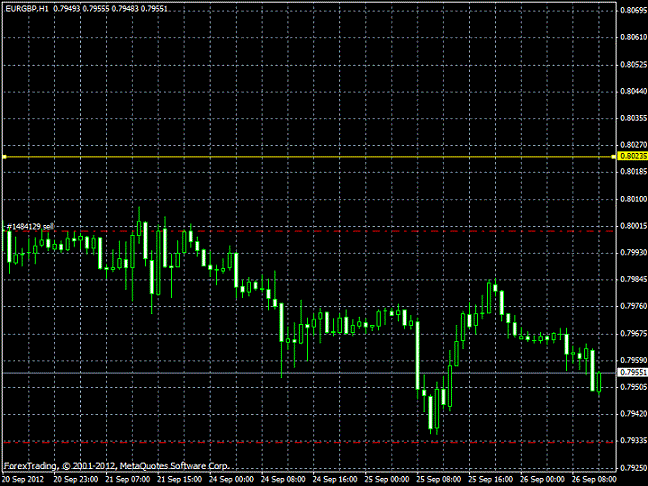


The yellow line is my stop loss. the first red line is where I opened the trade (0.8000) on the 21st of September, the second is where I predicted the price to end up (0.7932). I was almost exactly correct, and I closed my trade around 0.7934 on the 25th of September.

So you've seen a real life profitable trade, which earned over 600 Swiss Francs.

Thanks for reading,

Jr

www.twitter.com/jr_dot

Thursday, 20 September 2012

So Switzerland did something interesting (part 2)

Continuing from the last post (for those interested in Forex)...I am going to present a method that can be utilized even by novice traders to gain profits.

'Scalping' is a method that describes Forex trades that are very quick. Usually a trader is in and out of the market in minutes, rather than days or weeks. The trader is looking to take small profits regularly, rather than long term trades to take advantage of an uptrend or downtrend.

As previously discussed, the Swiss Bank's Vice Chairman (Jean-Pierre Danthine) has said the 1.20 EUR:CHF floor would be maintained with the 'utmost determination'.

So if the lowest the exchange rate will be (whilst the floor is maintained) is 1.20 - how can traders make money from this?

Simple - When the market drops near to 1.20, this is a signal to go long. As the price is not going to go down further, the only way the price can go is up. Although the gains are small, some money is better than no money!

This is a graph showing the EUR:CHF 1.20 floor
EUR:CHF from 15/05/2012 to 19/09/2012

If you were able to set your stop loss (red) a bit below this 1.20 floor to protect yourself, and your take profit around 1.2012 (yellow). Shorting the market close to 1.20 would have generated small but quite regular profits. This is ideal for the novice trader who is looking to build up their account.

Recently the EUR:CHF has weakened to its lowest levels in over eight months. If it was to return to its lower levels, this situation would once again give the opportunity for scalping (as long as the Swiss Bank maintains its plans for the 1.20 floor). Look out for this!

Thanks for reading,

Jr

twitter.com/jr_dot


Tuesday, 18 September 2012

So Switzerland did something interesting (part 1)

I went to a public lecture at LSE earlier this week. I didn't want to go initially, but thankfully I was convinced to go.  It was really informative and interesting and it's something I want now want to do more regularly, so thanks to the person that made me go! (You know who you are).

The Speaker was Heiner Flassbeck, who wikipedia tells me was once the State Secretary in Germany's Federal Ministry of Finance. Mr. Flassbeck is also the Chief Economist at the United Nations Organization for Trade and Development, so this guy knows his stuff!

The topic for the lecture was 'Policies for Inclusive and Balanced growth'. Having done a degree in Economics with Politics, I was happy I was able to understand pretty much all of what Mr Flassbeck discussed.

Without going into everything included in the 90 minute lecture, two things happened during the that stuck with me.

Firstly - during the question and answer section, one of the guests at the lecture burped into his microphone when he was asking a question, and then carried on as if nothing happened. This was in a room full of about 300 people. My companion and I were trying so hard not to laugh out loud that we both began to sweat.

Secondly - Mr. Flassbeck very briefly mentioned something quite brave that the Swiss Central Bank have done, which had relevance to my Forex trading. It's also the main focus of today's slightly longer blog entry.

About a year ago, the Swiss Central Bank announced plans to peg it's currency (CHF) to the Euro (EUR), as it was overvalued. Let's say a 'normal' exchange rate for Euro to Swiss Franc is 1 Euro to 1.2 Swiss Francs - which is  (EUR:CHF 1.20). If the Franc then strengthened with respect to the Euro, and became 1.1, then 1 Euro can now buy less Swiss Francs than before.

Conversely, this means that those exporting goods in Switzerland will now lose out, as those holding Euros will spend less on Swiss goods, as they have become more expensive. It also impacts the tourism industry as people will not want to go to Switzerland if the Franc is expensive.

The Swiss Bank's plan was to purchase a lot of Euros to bring EUR:CHF up to 1.2 again. Whenever the price threatened to fall below this, Euros would be purchased so that the exchange rate 'floor' was at 1.2.

The ramifications for this gave a unique opportunity for Forex traders to make consistent profits, with small risk. It involves a trading method known as 'scalping'. This will be explained in part 2 of this blog, which I have separated for those who have knowledge of the Forex trading.

Thanks for reading,

Jr

twitter.com/jr_dot